In most commercial buildings, the HVAC system stays out of sight until something goes wrong. Once it does? Suddenly, a retail floor is clearing out, an office is getting uncomfortable, and a facility manager is making calls instead of running the building. In Cary and across the Triangle, where a single week can swing from humid heat to a sharp cold snap, that kind of surprise is expensive in every way that matters.
The critical question to ask in this case is simple to ask, but harder to answer: do you service equipment on a fixed schedule and absorb the up-front cost of doing so, or do you let the equipment tell you when it’s failing?
Preventative maintenance has been the long-term, money-saving default for decades, until now. In today’s environments, IOT sensor-driven predictive maintenance is changing the equation for the better. Let’s explore how the two compare, what the sensors actually do, and why using them together helps keep commercial HVAC running.
What Is Preventative Maintenance?
Preventative maintenance is time-based. Equipment is serviced at set intervals, such as quarterly, seasonally, or after a certain number of run hours, regardless of how the system happens to be performing that day.
Once the timer trips, the process follows an “oil-change” style model for a building: change the filters, check the belts, clean the coils, tune the burner, and test the safeties on a schedule you can put on a calendar.
This approach remains useful because many failures follow a predictable pattern. Filters load up, belts stretch and crack, bearings dry out, and combustion can drift out of tune over a season. Addressing those issues on a schedule helps keep a system efficient and prevents the gradual decline that can quietly raise energy use. It’s also the foundation of recognized industry practice; the ANSI/ASHRAE/ACCA Standard 180.
The limitation with this approach comes down to timing. Preventative maintenance assumes some problems will wait until the next scheduled stop, but the failures that cause the worst downtime often don’t. A well-run commercial HVAC maintenance program narrows that window, but it can’t close it entirely on its own.
So what then? Simple: Organizations evaluate if a predictive maintenance schedule is the best path forward.
What Is Predictive Maintenance?
Predictive maintenance changes what triggers service. Instead of the calendar deciding when to act, the equipment’s actual condition does. Service happens when the data shows a component beginning to drift; not before it is needed and not after it has already failed.
The basic logic with this approach is similar to what experienced technicians have always done informally, but with continuous monitoring that makes it measurable. A technician who has worked on a building for years may hear when a fan sounds off or recognize when a compressor is laboring. Condition-based maintenance formalizes that instinct by monitoring vibration, temperature, current, and other telltale trends, then acting when a reading moves from normal into an early-warning range.
The Role of IoT Sensors in Commercial HVAC
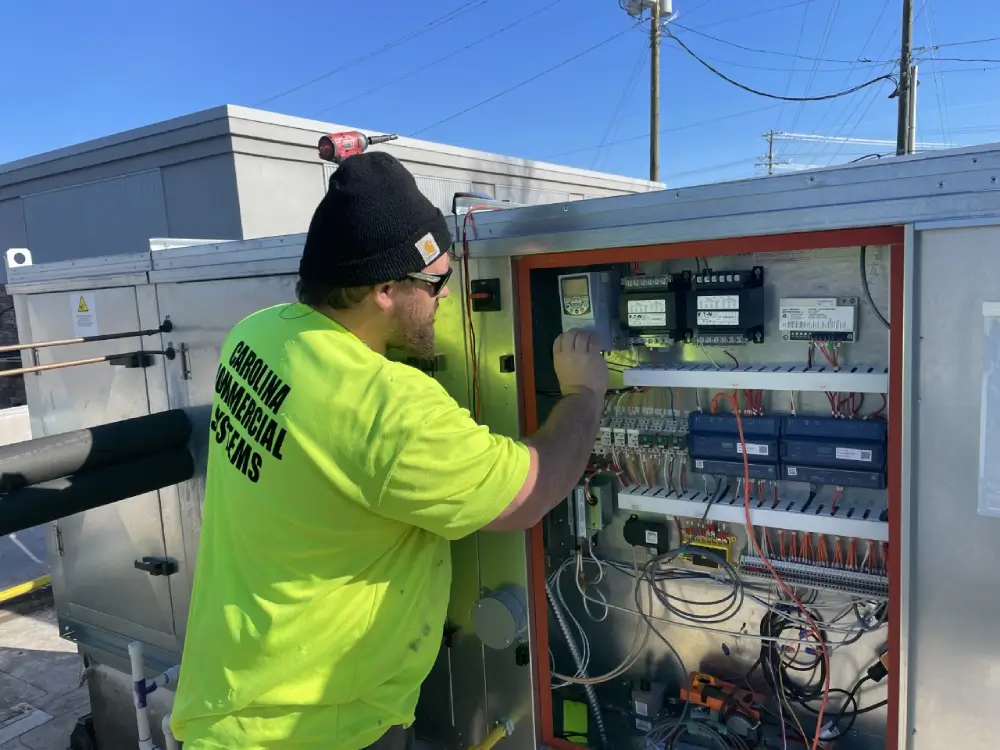
Predictive maintenance depends on the equipment being able to report on its condition, and that’s what IoT sensors make possible. Small, networked sensors mounted on and around HVAC equipment take continuous readings and send them somewhere a person or piece of software can monitor them.
We will note: Any one reading by itself is just a number. The value comes from looking at the readings together through a dashboard or analytics layer that can identify a trend. This is the role of fault detection and diagnostics, where software uses operational data to identify a problem and, increasingly, isolate the root cause.
Preventative vs. Predictive: A Practical Comparison
Not sure which path is the best path for your organization? Our experts put together this brief comparison chart to help simplify the decision-making process.
| Preventative | Predictive | |
| What triggers service | The calendar or run hours | Real equipment condition and data |
| What it catches well | Wear items on a predictable curve | Developing faults between scheduled visits |
| Main weakness | Blind to problems that start mid-interval | Requires sensors, connectivity, and a plan to use the data |
| Downtime risk | Moderate — surprises still slip through | Low — most failures are caught early |
| Best fit | Nearly all equipment, as a baseline | High-value, high-runtime, or mission-critical systems |
While some may choose one way forward, it’s not necessarily a requirement. Predictive maintenance doesn’t replace preventative work; it adds another layer to it. Filters still need to be changed and burners still need to be tuned on a schedule, while sensors help catch failures that do not follow a schedule. Buildings that treat the two as an either/or choice can end up with the limitations of whichever approach they select. Layering them provides the baseline discipline of preventative service along with the early warning of predictive monitoring.
How Predictive Maintenance Cuts Downtime
When a fault is caught via predictive maintenance while it is still small, it’s less likely to cascade into the kind of failure that takes an entire system offline. A flagged bearing, for example, can be replaced during a planned visit; instead of seizing and taking a motor with it on the hottest afternoon of the year.
That early warning changes how a maintenance operation works. Emergency calls can drop because fewer problems reach the emergency stage. Parts can be staged ahead of time when the team knows a component is trending toward replacement rather than having to source it after a breakdown. Repairs can also be scheduled around building operations instead of interrupting them. The end result: Equipment may last longer and run more efficiently because it spends less time operating in a degraded condition.
Is Predictive Maintenance Right for Your Building?
Not every system needs a sensor package, and a good partner should tell you that. Predictive monitoring tends to provide the quickest value on equipment where downtime is most disruptive: large-tonnage rooftop units, chiller and boiler plants, VRF systems, and anything serving temperature-sensitive operations or a building that cannot simply close for a day.
For most facilities, a hybrid approach makes the most sense. Maintain a solid preventative program across the building, then add sensor-based monitoring to the critical assets where an early warning can pay for itself through a single avoided failure. This targeted approach also keeps the investment sensible by focusing the technology where the risk is greatest.
The sensors are only part of the equation, however. The team interpreting them matters just as much. Data without judgment can become useless, quickly. It won’t, though, when it’s paired with technicians who understand what a changing vibration signature or a gradual temperature trend means for your specific equipment. When that expertise is paired with a thoughtful design-build approach to controls and system upgrades, monitoring becomes part of how the building operates rather than a dashboard nobody watches.
The Bottom Line
Preventative maintenance provides the foundation, and it’s not going anywhere. Scheduled, structured upkeep remains essential for keeping a commercial system efficient and compliant. IoT sensors and predictive maintenance add something a calendar can’t: the ability to identify developing faults that can cause the most disruptive downtime before they reach the point of failure. Together, they shift HVAC maintenance from reacting to problems toward staying ahead of them.
Carolina Commercial Systems has kept Triangle buildings comfortable for more than four decades, helping facilities across Cary build maintenance programs around their equipment and level of risk; from foundational service to sensor-driven monitoring for critical systems. To talk through the right approach for your building, explore our mechanical services or call 9196797190.